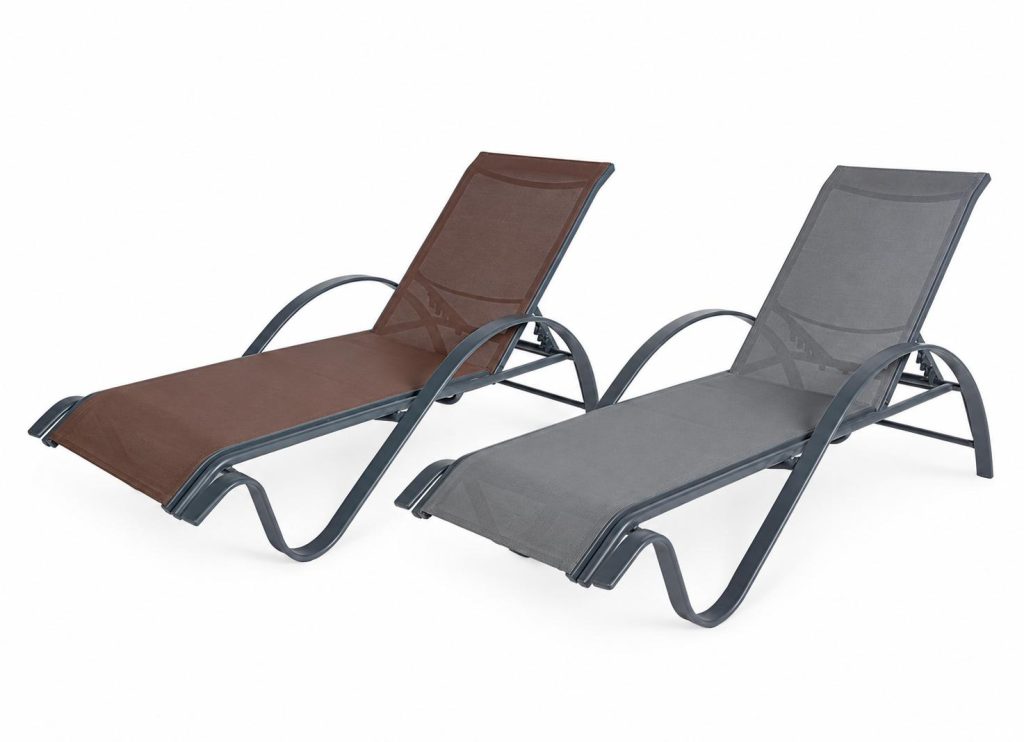
When choosing garden and patio furniture, the weather resistance of the materials is one of the most important factors to consider. This is because rain, damp and salt spray can affect how well it holds up, particularly in coastal areas such as the Canary Islands.
One of the most commonly used materials in outdoor furniture is aluminium; however, there are many questions about the protection it offers and the maintenance it requires. Specifically, people often wonder whether aluminium rusts and how it fares when left out in the open.
In this guide, we explain what happens to aluminium outdoors, what factors affect it and how to look after it so that your outdoor furniture stays as good as new for many years to come.
-
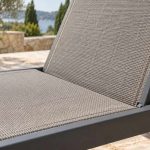
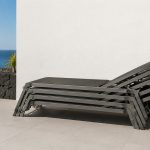
 Lanzarote Taupe Sunbed175,00€
-
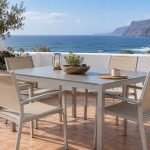
Canarias Aluminium Round Table 90219,00€
-
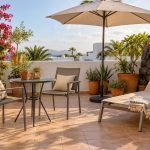
Solar Chair92,00€ 98,00€ Price range: 92,00€ through 98,00€


Does aluminium really rust?
Yes, aluminium oxidises when it comes into contact with oxygen, but this process does not damage the furniture – as happens with other metals such as iron – but rather protects it. The reaction produces a thin layer of aluminium oxide, also known as alumina, which acts as a protective barrier and prevents deterioration from spreading into the metal.
Therefore, when people say that aluminium does not oxidise, they are oversimplifying its behaviour. It is more accurate to say that it does not oxidise in the same way as iron, as it does not develop the characteristic reddish rust associated with that metal. Instead, a thin film forms which protects the material and explains its good resistance to corrosion, although this does not make it immune to deterioration under certain conditions, such as prolonged exposure to salts and moisture.
Why does aluminium not oxidise like other metals?
The difference lies in the characteristics of the oxide layer that forms on each material. In the case of iron, rust is porous and tends to crack and flake off, leaving new areas exposed to water and oxygen. Thus, corrosion continues to affect the metal and, over time, the deterioration progresses into the interior of the piece, eventually weakening it.
In contrast, aluminium oxide forms a compact film that adheres very strongly to the surface. As it does not allow oxygen to pass through nor does it flake off, it acts as a barrier that slows down the reaction and prevents the metal underneath from continuing to oxidise – a phenomenon known as passivation.
Furthermore, if friction or a scratch removes part of the aluminium oxide layer, it reforms when the material comes into contact with oxygen. This is why aluminium withstands rain, sunlight and humidity for years without needing to be painted, although the effectiveness of this protection depends on the conditions of exposure, as certain agents can attack this barrier and lead to localised corrosion.
How do water, salt and other agents affect aluminium?
We have already seen that aluminium can oxidise and that alumina provides excellent protection for the metal against corrosion. However, its resistance depends on the conditions to which it is exposed, as factors such as rain, persistent damp and salt build-up have different effects on its surface. The finish of the furniture, its maintenance and contact with substances that can alter the protective layer also play a role.
Does aluminium rust when exposed to water and damp?
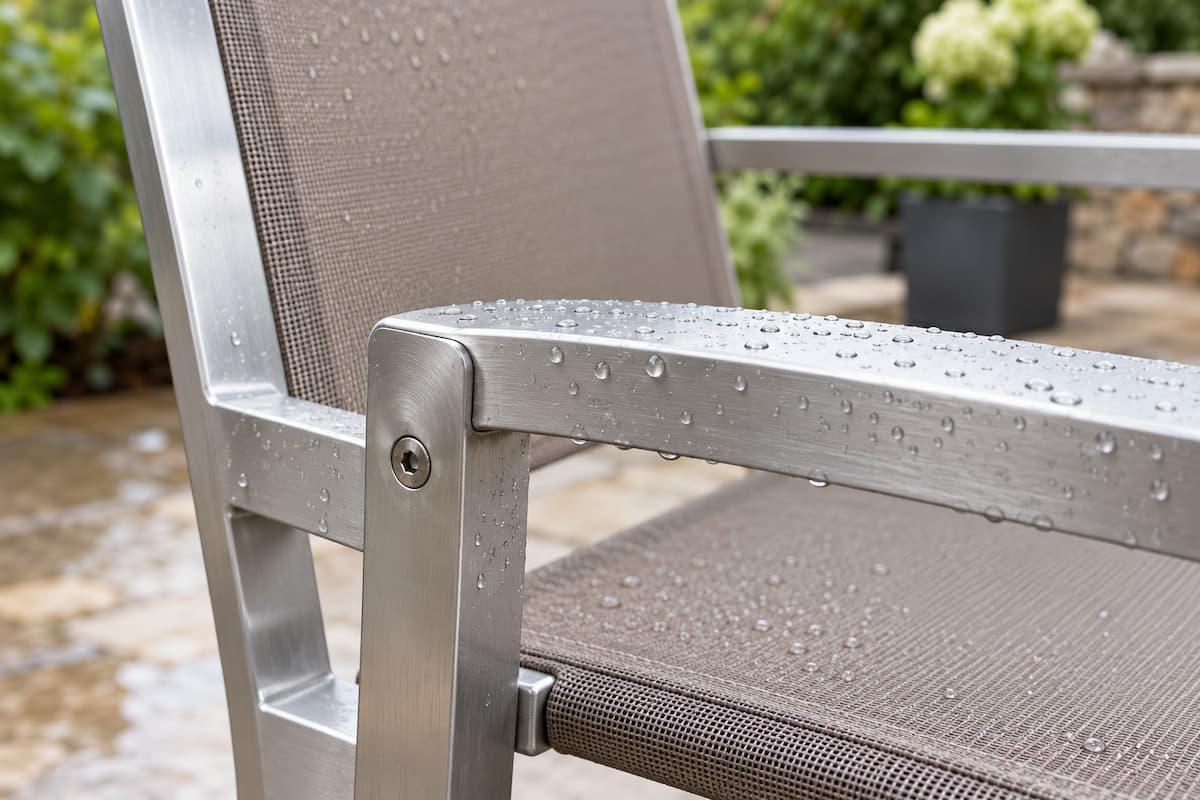
Rain and splashes of fresh water are not a problem for aluminium furniture designed for outdoor use. Its protective coating enables it to withstand these conditions well, so it does not deteriorate simply because it gets wet.
However, standing water and persistent damp can promote corrosion, particularly if they contain salts or other substances that compromise the material’s natural protection. The risk is greatest at joints, in recesses and in areas where water remains trapped for long periods. It is therefore advisable to ensure good drainage and to prevent the furniture from remaining in constant contact with wet surfaces or under covers where condensation builds up.
How does salt affect aluminium?
In coastal environments, salt spray can settle on furniture even if it is not in direct contact with seawater. The chlorides present in the salts carried by the sea breeze can damage the protective layer on the aluminium in certain areas and, in the presence of moisture, promote pitting corrosion, which involves small cavities forming on the metal’s surface.
Furthermore, salt dissolved in moisture acts as an electrolyte, that is to say, it facilitates the reactions that degrade aluminium’s natural protection. The result is usually a white or greyish powder and, over time, a rough surface. For this reason, on terraces near the sea, it is advisable to choose furniture with a good finish and to rinse it with fresh water periodically to remove any traces of salt spray.
What about chlorine from swimming pools and cleaning products?
Swimming pool water can affect aluminium depending on its composition, its pH and the finish of the furniture. If splashes are occasional, they do not usually damage outdoor furniture; however, if they occur repeatedly and are not rinsed off, the build-up of residue can weaken the finish and encourage the appearance of pitting.
Something similar applies to cleaning products. The oxide layer is stable within a pH range of approximately 4 to 9, but if exposed to higher or lower levels, it can be damaged. It is therefore advisable to avoid concentrated bleach, aggressive descaling or degreasing agents, highly acidic products and abrasive scourers, which can also scratch the finish. For routine cleaning, simply use water and mild soap, always following the manufacturer’s instructions.
Does anodised aluminium oxidise?
Anodised aluminium undergoes an electrochemical treatment that transforms the metal’s surface and creates a layer of aluminium oxide that is thicker than the one that forms naturally when exposed to air. It is, therefore, a controlled oxidation process that enhances its protection. This film does not peel or flake off like a paint finish; it also hardens the surface, making it more resistant to abrasion and improving its resistance to corrosion.
However, anodised aluminium can still be subject to corrosion, although a proper anodising process reduces this risk. The effect depends on the thickness of the anodised layer, the quality of the treatment and the sealing of its pores, which helps to limit the ingress of corrosive agents.
For this reason, anodised aluminium is a suitable choice for numerous outdoor applications. However, the build-up of salts, contact with highly acidic or alkaline substances, and deep damage can compromise its protection.
Furthermore, if a scratch reaches the metal, the exposed area will form a new protective film on contact with the air, but it will not regain the thickness or properties of the anodised finish.
How can you prevent corrosion on aluminium furniture?
Aluminium furniture requires simple maintenance, but it is advisable to tailor your care routine to its finish and the environment in which it is used. If you’re wondering how to prevent aluminium from rusting and suffering corrosion, you can follow these recommendations:
- Clean with mild products: use water, mild soap and a sponge or soft cloth, then rinse to remove any traces of detergent. Avoid using harsh products and abrasive scourers that could damage the surface.
- Rinse with fresh water regularly: on coastal terraces or near a swimming pool, it is advisable to rinse the furniture with fresh water before salt and chlorine residues build up and damage the surface.
- Do not allow water to pool: check that water can drain away through the drainage points provided by the manufacturer and dry any areas where water has pooled, paying particular attention to joints and corners.
- Check the finish for damage: if you notice peeling paint, dents or scratches that have left the metal exposed, it is advisable to repair the damage as soon as possible. Consult the specific treatment recommended for the finish in question.
- Check screws and fittings: contact with other metals, in the presence of moisture, can cause galvanic corrosion. Ideally, use aluminium or stainless steel fixings, insulated from the furniture wherever possible.
- Take care when storing: keep furniture clean and dry in a well-ventilated place. If you use covers, choose breathable ones and avoid covering wet furniture, as condensation can keep the surface damp.
How do you remove rust from aluminium?
Before cleaning an area that appears to be rusted, it is advisable to check what type of damage it has. Usually, it is a whitish powder on the surface that can be wiped off easily, but if the metal has pitting, it requires more care. The natural layer of oxide that protects the aluminium must not be removed.
- Identify the finish of the furniture: check whether the aluminium is lacquered, anodised or uncoated. Consult the manufacturer’s instructions before proceeding, as the products required may vary depending on the finish.
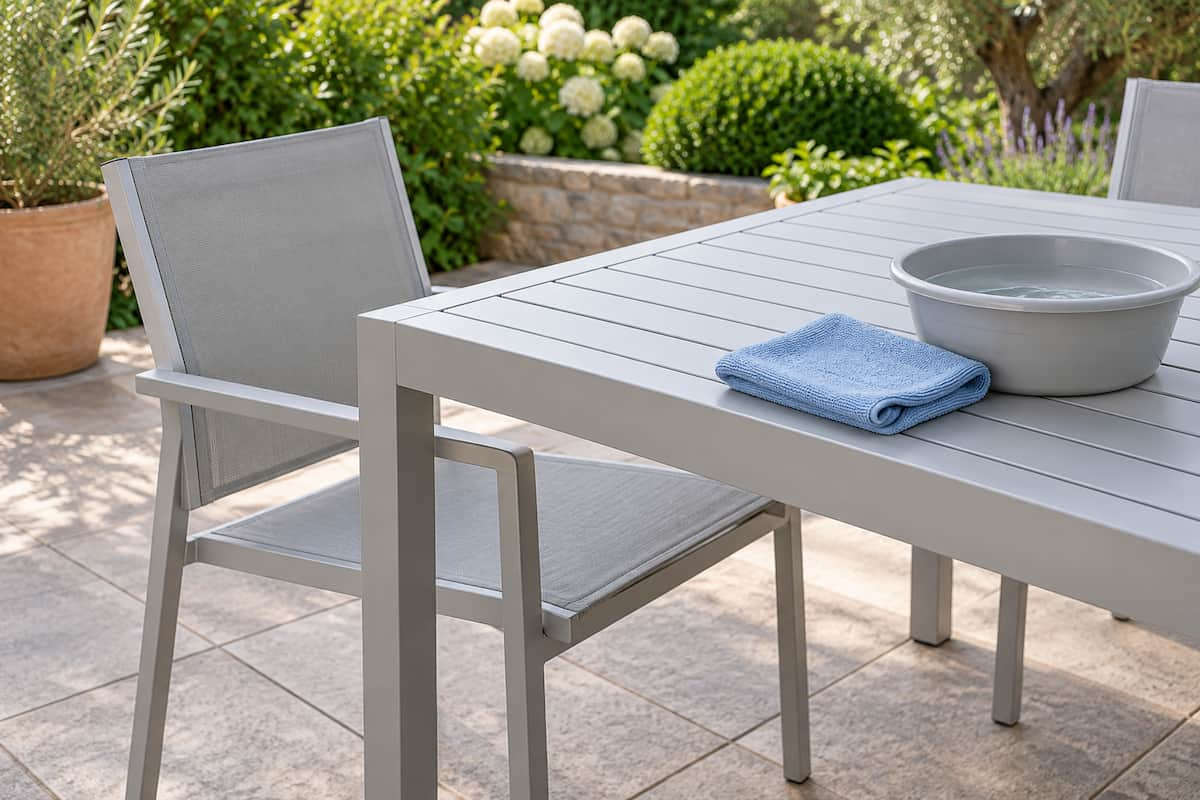
- Start with a basic clean: remove any dirt with a cloth and clean with water and mild soap. Rinse and dry to check whether the mark has disappeared or if the damage remains. This is often enough to remove loose, superficial deposits.
- Treat stubborn stains: use a cleaner suitable for the type of finish, following the instructions and testing it first on an inconspicuous area. Rub gently, using a cloth or a soft-bristled brush to avoid scratching the material.
- Assess any remaining damage: if there are pitting, flaking paint or damaged areas, cleaning alone will not be sufficient to rectify them. In such cases, it is best to consult the manufacturer regarding the appropriate repair, as sanding the furniture is not always advisable.
Frequently asked questions about aluminium oxidation
How long does it take for an aluminium oxide layer to form?
The process begins almost immediately when aluminium is exposed to oxygen in the air. Within seconds, a very thin film appears which protects the surface and slows down further oxidation. Over the course of days and weeks, this initial layer thickens until it reaches its final thickness, although the rate at which this happens depends on environmental conditions.
Does the oxide layer change the colour of the aluminium?
The natural oxide layer is so thin that it is transparent and does not visibly alter the colour of the metal. What may happen over the years, however, is that the surface loses its shine and takes on a more matt appearance, although this may also be due to dirt, mineral deposits or slight surface corrosion.
What are the white stains that sometimes appear on aluminium?
These are traces of surface corrosion – a whitish or greyish powder consisting of aluminium oxide and hydroxide. They usually appear as a result of contact with salt, chlorine or moisture that has accumulated between the parts. In most cases, these are superficial and can be cleaned with water and mild soap. If, whilst cleaning, you notice the surface feels rough or you spot small pits, it is advisable to consult the manufacturer to assess the appropriate treatment.
What happens if a piece of aluminium furniture gets scratched?
It depends on the finish and the depth of the scratch. If it reaches the metal, the exposed area forms a new natural layer of oxide on contact with the air. However, if the aluminium had a coat of paint or was anodised, these cannot be restored, so a repair may be necessary. Furthermore, the scratch will remain visible even if the natural layer regenerates.
What is the difference between anodised and lacquered aluminium?
Anodising is an electrochemical treatment that thickens the metal’s oxide layer. In contrast, lacquering involves applying a coat of paint to the aluminium surface. Both can improve protection and appearance, but anodising forms an integral layer that does not flake off and retains the metallic look, whilst lacquering is an external layer that can chip.
Is aluminium a good choice for outdoor furniture?
Yes, it is one of the best materials for outdoor furniture. It is lightweight, withstands rain and sun well, does not rust like iron and requires very little maintenance, which is why it is commonly used for outdoor chairs, tables and sun loungers. To extend its lifespan, it is advisable to choose furniture with a good finish and to clean it regularly with water and mild soap, as well as to remove salt deposits in coastal areas.