Ideas for securing a parasol so it doesn’t blow away on windy days
Parasols are the perfect allies for enjoying any outdoor space on sunny days. Whether in a private garden or on a bar terrace, parasols allow you to alternate between sun and shade depending on your preferences at any given moment, creating a more comfortable and pleasant environment even during the hottest hours of the day.
However, when it is windy, problems arise, as if the parasol is not properly secured, it can blow away or fall over, causing damage to property and even accidents. That is why, in this post, we are going to give you several ideas for securing a parasol, as well as a series of simple tips to prevent it from blowing away.
To begin with, we will explain the most common methods for securing a terrace parasol, so you can choose the one that suits you best:
Weighted base: this is the most practical and widespread solution, and also our favourite, so we will discuss it in detail later on. For now, just remember that it is the easiest option to install, as well as allowing you to move the parasol around as needed.
Fixed ground anchor: this is a useful alternative if you are not going to move your parasol, as it involves embedding a metal piece, usually stainless steel, in the ground, to which the parasol pole is attached. This solution offers great stability and eliminates the risk of the parasol tipping over, although it requires professional installation and is more expensive than a mobile base.
Clamps: this is a fastening that attaches to railings, walls or even tables, keeping the parasol stable without taking up floor space. However, you must ensure that the support is compatible with the thickness of the parasol pole. Furthermore, this system does not usually offer as much stability as the previous ones.
Built-in or concealed anchorage systems: this is a modern alternative that involves integrating the base into the paving or under decking. Although it allows you to maintain the aesthetics of the terrace without visible elements and offers great resistance, it requires some construction work and is therefore the most expensive solution of all the options.
Bases for securing parasols: the definitive solution
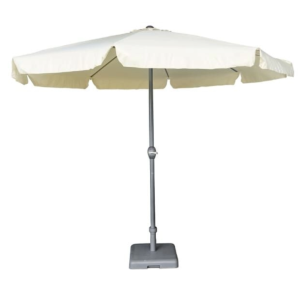
Parasol bases are undoubtedly the most versatile and balanced option for ensuring that your parasol does not blow away on windy days. Firstly, this solution allows you to relocate the parasol whenever you need to, simply by removing the bases, moving it and replacing them once you have chosen the new location.
What’s more, they are very easy to install and you can do it yourself without any problems, taking care not to hurt yourself with them, as they are quite heavy. In this sense, as they do not require any installation or advice to use them, they are one of the most economical options.
The only alternative that can be compared to the bases in terms of price are side clamps, but these offer much less stability. Despite being mobile, the bases provide great resistance, ensuring that your parasol does not move at all thanks to their weight.
In addition, there are bases made of different materials, designs and weights, which you should consider depending on the type of parasol, exposure to wind and the stability you want. The main alternatives are:
Concrete bases: these are the most resistant and recommended for ensuring good support. They consist of a single piece of concrete whose natural weight prevents sudden movements and provides excellent support. Although they come in different weights, a 25 or 30 kg base is usually sufficient, but this will always depend on the size of your parasol.
Fillable bases: these are resin or plastic bases that can be filled with water or sand. Although they are easier to handle when empty, you will have to fill and empty them, making them slightly less convenient to use.
Bases with wheels: a particularly practical alternative for terraces or patios where you want to change the location of the parasol frequently. The wheels allow you to move it effortlessly and usually incorporate brakes to keep the parasol in place once it is positioned.
Cross bases: for parasols with a cross-shaped base, you will need bases that fit this size. They can also be made of concrete or be fillable, and two are usually used, one on each side to ensure the stability of the parasol.
How to prevent your parasol from blowing away? Key tips
But in addition to choosing the right base, there are also a number of things you can do to ensure that your parasol does not fall over or blow away on windy days. Here are some simple tips on how to secure your garden parasol:
Choose a good quality parasol: the most important thing is to buy a sturdy parasol, made from quality materials that ensure its stability and resistance to outdoor conditions. For the frame, it is best to opt for aluminium, an economical yet resistant material, while for the fabric parts of a parasol, polyester is the best option, with a recommended thickness of 180 g/m2.
Choose the location carefully: place the parasol in areas that are fairly sheltered from the wind, preferably next to a wall or fence that acts as a natural barrier. It is best to avoid very exposed or elevated areas, where wind gusts are more intense.
Adjust the weight of the base: make sure that the weight of the base is proportional to the diameter and type of parasol. For standard parasols, a 25 or 30 kg base is usually sufficient, but it is best to ask the shop staff for advice based on your specific needs.
Check the anchors frequently: periodically check that the screws and fastenings on the parasol are tight. Although a good-quality parasol will last for many years, continuous use and exposure to the elements can loosen some fastenings over time.
Tilt the parasol according to the wind direction: if your parasol is tiltable, take advantage of this to orient it so that the wind does not hit it directly, tilting it slightly to reduce the risk of it tipping over.
Close it on windy days: even with a solid base and good quality materials, no parasol is designed to withstand strong gusts of wind. Therefore, on particularly windy days, it is best to close it to avoid accidents.
Add reinforcements if necessary: in particularly windy areas, you can add extra weights or complementary fastening systems, such as straps or tensioners, to increase stability without affecting the aesthetics.
Common mistakes to avoid when securing a parasol
Finally, we will tell you what the most common mistakes are when securing a parasol, so that you can identify them and enjoy your terrace without any mishaps:
Using a base that is too light: this is one of the most common mistakes, as if the base is not heavy enough for the size of the parasol, it can move or tip over more easily.
Placing the parasol on an uneven surface: a sloping or uneven floor prevents the base from being secured properly, affecting the balance of the parasol and increasing the risk of it falling over.
Not adjusting the pole properly: leaving the pole too loose or not fitting it properly into the base can cause it to move in the wind or even damage the fastening mechanism.
Choosing low-quality materials: opting for plastic poles or thin fabrics contributes to the umbrella deteriorating more easily, meaning you will have to replace it sooner.
Not closing it when not in use: leaving the parasol open overnight or on windy days accelerates fabric wear and increases the risk of it falling over or blowing away.
Using improvised fastening systems: resorting to ropes, stones or homemade weights can be ineffective and even dangerous, as these types of solutions are not specifically designed for parasols and can lead to accidents.
Para ofrecer las mejores experiencias, utilizamos tecnologías como las cookies para almacenar y/o acceder a la información del dispositivo. El consentimiento de estas tecnologías nos permitirá procesar datos como el comportamiento de navegación o las identificaciones únicas en este sitio. No consentir o retirar el consentimiento, puede afectar negativamente a ciertas características y funciones.
Funcional
Always active
El almacenamiento o acceso técnico es estrictamente necesario para el propósito legítimo de permitir el uso de un servicio específico explícitamente solicitado por el abonado o usuario, o con el único propósito de llevar a cabo la transmisión de una comunicación a través de una red de comunicaciones electrónicas.
Preferencias
El almacenamiento o acceso técnico es necesario para la finalidad legítima de almacenar preferencias no solicitadas por el abonado o usuario.
Estadísticas
El almacenamiento o acceso técnico que es utilizado exclusivamente con fines estadísticos.El almacenamiento o acceso técnico que se utiliza exclusivamente con fines estadísticos anónimos. Sin un requerimiento, el cumplimiento voluntario por parte de tu proveedor de servicios de Internet, o los registros adicionales de un tercero, la información almacenada o recuperada sólo para este propósito no se puede utilizar para identificarte.
Marketing
El almacenamiento o acceso técnico es necesario para crear perfiles de usuario para enviar publicidad, o para rastrear al usuario en una web o en varias web con fines de marketing similares.